On Friday we went walking and ended up at the Government Gardens on Sulphur Point, Paepaekumana. We hadn't intended to go there, but we were visiting the Rotorua Visitor Information Centre in downtown Rotorua, and came away with an armful of brochures, from the Redwoods Nighlights Treewalk, to Whakarewarewa Valley, to Te Puia, Duckboating, and Glowworm kayaking tours. Since the Government Gardens were just a block or two away, we spent time enjoying New Zealand's mixture of Maori culture alongside Her Majesty's England.

Elder Rooks at the Prince's Gate entrance to the Rotorua Government Gardens. The area is of historical significance to the local Maori, with battles having been fought here. The Maori gave 50 acres of the land to the British Crown in the late 1800s. The combined Paepaehakumanu and Motutara area became known as the Sanatorium Reserve, or more commonly, the Government Gardens.

Earlier in the week, I was sitting at my computer desk and saw a young purple swamp rooster rushing across the lawn toward where Mr. and Mrs. Pukeko usually forage. I grabbed my camera to record the fireworks and saw the younger rooster attacking Mr. Pukeko.

They went at it for awhile under the red rhododendron, with several hens idly watching nearby.

Also a curious yellow-banded Kourarini goldfinch

Mr. Pukeko and his challenger finally fell into deep discussion. I've saved the final Mr Pukeko photo for the end of the blog post, as usual.

Now for some plants. A nice little growth of the common lawn daisy, or English daisy, bellis perennis. This grows everywhere, in everyone's lawns.

A clump of Forget-me-not near the thermal stream. I found a brand-new Ryobi tape measure in the undergrowth not far away, which made Elder Rooks super happy. I also found a hatchet and he found two rusty saws. Now if we could just find a nice sharp shovel, some pliers, a battery-operated drill, a wrench set, and an aluminum ladder.

Just across the fence is one of the ubiquitous Rimu trees, Dacrydium cupressinum of the cypress family, "a large evergreen coniferous tree endemic to the forests of New Zealand. It is a member of the southern conifer group, the podocarps." A very tall and beautiful tree.
 |
The needles are spiky and weeping.

We went to Mary's house to work on her gutters. On the way, we stopped to take a picture of the lake. To the left is a jetty in front of someone's lakeside property

And the ducks and geese and swans

Elder Rooks cleaned about 10 pounds of sludge from the gutters front and back. We borrowed the ladder from a ward member.

Then Elder Rooks pressure washed the gutters, which made them look almost new. Mary was thrilled. We came back later and Elder Rooks scraped off the old caulking, so the new caulking can go on clean.

This inspired us to clean the soffits and eaves of our own house, which needed it. It was raining so I was wearing my New Zealand rain hat. I am also wearing thermal underwear and lined rubber boots.

We came across this Reduced to Clear discount food store, or as Heidi likes to say, the Used Food Store. We came away with some frozen potstickers, which I cooked and took to the weekly missionary dinner at Pres. Winiata's house. The youngest daughter loved them.

We came home with some of Sis. Winiata's Purini Mamaoa, steamed pudding traditionally cooked with the Maori hangi pit dinner. Her version was delicious, especially with custard straight from the carton. Why there is no U.S. equivalent of vanilla custard in the dairy aisle is beyond me. Someone could make a killing.

While we're on the subject of food, this brand of South Island Jam, Anathoth Raspberry, Plum, Strawberry and Blackberry, which I bought at Pack'N'Save, is among the best jam I've ever tasted.

And while I like Bundaberg Ginger Beer, the Burgundee (grape) Creaming Soda is my favorite.

Also, of all the New Zealand cookies, of which there are many, Arnott's Mint Slice is the best.

We went to visit Robbie and Wiki again. Robbie was home so we had a wonderful time. Sometimes it is hard to see the box numbers, and Elder Rooks prefers not to back our rented car along very long narrow driveways, so we usually park on the curb lawn strip like everyone else.

Here is our house number at the end of the lane. The New Zealand Post keeps delivering my Amazon packages to the AirBnB next door since Google Maps has mis-marked the addresses. I made an edit to our street map hoping they will put it to rights. You can see how clean the soffits and eaves are now, although I couldn't get all the lichen off with my push broom.

On Thursday this sweetheart, Alleen, came to work on family history. We found some records in her Scottish genealogy, and she was thrilled. She is a happy soul and communicates happiness to those around her.

On Friday we took the walk to the Visitor's Centre. One thing about roundabouts, as convenient as they are to drivers, they are not convenient to pedestrians. When traffic is busy we walked the extra distance to the street lights in order to cross the street safely. We ended up walking down Haupapa Street where I resisited the urge to visit the Mountain Jade store, which was stocked with hundreds of exquisitely carved pounamu greenstone jewelry. I may have to give in one of these days. This is apparently a backpacker's paradise, too, since we saw hostels all around the blocks nearby.
The Visitors Information Centre, where the helpful staff gave us maps and brochures

This is the Sir Howard Leslie Morrison OBE Performing Arts Centre, named for "Old Brown Eyes," the "Sinatra of New Zealand," a beloved performer and entertainer. We also visited the Rotorua Lakes District Council Building, looking for permission to photograph headstones at the nearby Kauae Cemetery. We were told to talk to the sexton of the Rotorua Cemetery and Crematorium, which we plan to do next week.

The Prince's Gate Hotel, a restored 19th Century building and landmark, across the square from the Government Gardens

The Te Runanga Tea Pavilion, built in 1902, with room for 40 dining guests

The Blue Baths, a city landmark, built in the Spanish Mission style. Originally built in 1886 for bathing in mineral springs. It was closed in 2021 because of seismic issues, although there has been some controversy about this.

Pollarded London Plane trees

I believe this tree is a California Coastal Redwood, Sequoia sempervirens, although I'm not sure. A redwood forest was planted not far from here as a source of commercial wood, but has since turned into a tourist attraction.

The needles are similar to those of the Western Red Cedar, Thuja Plicata, which grow in warmer, drier climates, and with which the California Redwood is often confused.

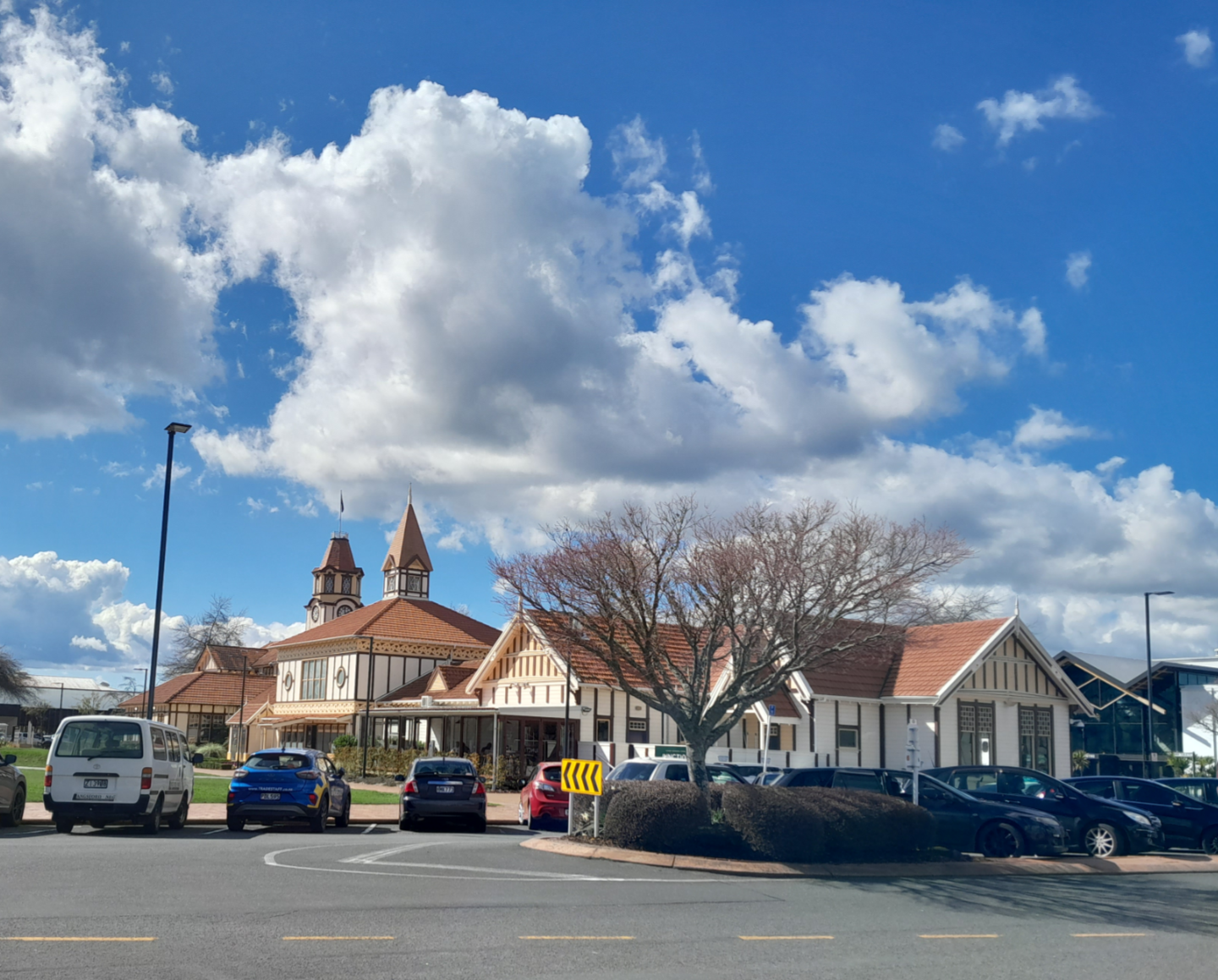
The Tudor-style museum at the Government Gardens. Built in 1903, it is at the site of croquet matches, lawn bowling and petanque. It was closed in 2016 for seismic reasons and may never be reopened. The Gardens also includes the Klamath Falls, Oregon, Rose Garden, in honor of Rotorua's Sister City.

On the way back from Government Gardens, we followed a different path through Kuirau Park and went through this foot bridge over mud pools

Called The Serenity Bridge, this belongs in a J.R.R. Tolkien movie.

Back to our swamp rooster saga. Mr. Pukeko sternly accompanied his new neighbor all the way off his property. Although Mr. Newcomer keeps hanging around trying to move in. It was only when Mr. Fabulous, the long-haired black cat, showed up that the little contretemps came to a sudden end.


