We left early enough Thanksgiving morning to meet up with the Welshes at the world-famous Hamilton Gardens. Its 18 collections are based on different themes: Paradise, Productive, Fantasy, Cultivar, and Landscape.

My favorite, the Italian Renaissance garden

Looking like a giant sundial, the Time Court is actually a recreation of an ancient Greek Pelekinon developed to measure time according to the angle and length of shadow. It can be used as a clock and a calendar--as long as the sun is shining.

There were many walkways leading in all different directions. One garden led into another

A mama duck with her ducklings

Elder Rooks is a good sport about being dragged from one garden to another

Rose Campion, silene coronaria. This is for you, Katie Kennington

Part of the White Garden

The Paradise Garden Collection. We didn't have time to visit all the areas in the 54 hectare (133 acre) gardens. Although it has been free to visit Hamilton Gardens in the past, this will change in 2024.

Bathrooms in New Zealand are referred to as Toilets, and since there are many visitors from all over the world, this sign was inside the women's toilet stalls.

With Elder Jack and Sister Charlene Welsh in the entrance to the Chinese Scholars' garden. Elder Welsh is a scholar himself and was a good tour guide

Seating and a stone bridge for scholars to sit and contemplate. Maybe play a game of chess or two

The Indian "Char Bagh" or "enclosed four part garden" was the original Paradise Garden. It was sometimes known as the "Universal Garden," not only for its widespread and long period of use, but because it represented the universe itself.

This form of garden spread throughout the Muslim world between the 8th and 18th centuries

A group of schoolgirls coming out of the Japanese Garden of Contemplation. In New Zealand they are known as "schoolies"

Typical Japanese elegant lines and sliding screens

We sat on the benches and contemplated awhile. I wouldn't mind having a Garden of Contemplation.

Dr. Casey K. will have to tell us if this is a proper translation.

The Italian Renaissance garden, with geometric shapes, fountains, and statues

An Indian family having their picture taken under the arches

The arches without the Indian family. I will have these at my Italian villa

Diana with her quiver of arrows, and white roses

I love cypresses. I will have these at my Italian villa as well.

Juliet's balcony

The Te Parapara Garden is New Zealand's only traditional pre-European Maori garden, focusing on original plants, techniques and food-gathering culture and storage. Included is palisade fencing (taepa), three forms of traditional Maori storehouses (pataka), a ceremonial gateway (waharoa) and ancestral pou, central pole.

Storehouse surrounded by taepa fencing

Seedlings of kumara, ipomoea batatas or sweet potatoes, poking out of the mounded hills. Kumara, brought in from other Pacific islands, was the staff of life to early Maoris. Bev, a Maori friend, gave me a loaf of delicious bread made with kumara mash.

Underground pit storage

Above ground storage to protect from animals

I believe these are mulberry leaves, which often look like birch leaves but can be uniquely lobed

The Tudor garden, reflecting sixteenth century English aristocracy's fascination with geometric patterns, symbols, and double meanings. The intricate knot garden is based on drawings by Didymus Mountain (pen name for writer Thomas Hill). Surrounded by mythical beasts, an arbor, and an Elizabethan wall, the corner building is a copy of Montacute House's stone pavilion

The Elizabethan Wall. I may have to add one to my Italian Renaissance garden.

Pan and his pipes

The sustainable garden, with its seeming-haphazard plantings and scarecrow

Pergola and stone whimsies in the Sustainable Garden

The raised beds in the working Kitchen Garden, which donates its produce to local soup kitchens

Lady gardeners in garden hats inspecting plants, obviously kindred spirits of mine

Entrance to the Picturesque Garden, which features scenes from Mozart's classic opera The Magic Flute, a musical "search for truth and reason, love and enlightenment"

At the center of The Magic Flute is the character Papageno, a half-bird, half-man who helps Prince Tamino find his true love, Pamina. Papageno himself would be content if he only had a wife, or, failing that, a girlfriend.

I really like this door, which says "Vernunft" over it. The German dictionary says Vernunft means Reason or Common Sense, which explains my liking for it. Again, Dr. Casey K., you can tell us if this is correct.

So we had our picture taken in front of it

The Waikato River winds through Hamilton, and through Hamilton Gardens

The beautiful entrance to the Mansfield garden, named for New Zealand writer Katherine Mansfield, depicting scenes from her famous story, "The Garden Party," which took place in 1907 Wellington. In "The Garden Party," Mansfield "explores class divisions and the characters' awareness of them; how elite prejudice against the working class perpetuates inequality while also revealing how interactions between different classes can spark empathy and understanding." (Cliff's Notes)
"The Garden Party" is not to be confused with Ricky Nelson's 1972 hit song "Garden Party," which memorialized his Stone Canyon Band being booed at Madison Square Garden. I don't know if there is any connection with the pink-edged ivory hybrid tea rose "Garden Party," which I have grown before.

The Welshes are having their own garden party while sitting on conveniently placed benches, where you can look out on the lawn with its food tent and string quartet
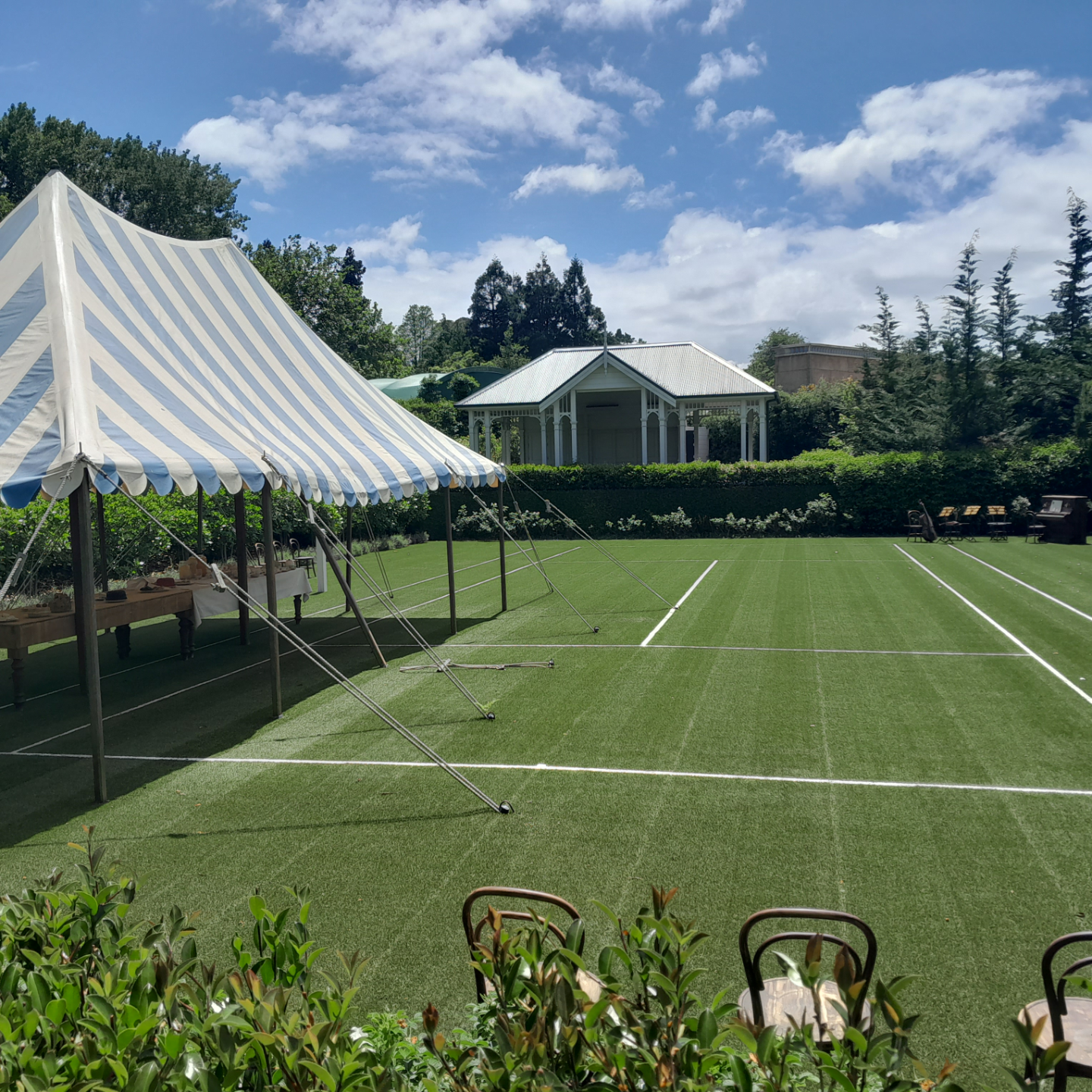
The string quartet is in the corner of the lawn tennis court

The design of the house is that of Mansfield's parents' Wellington home

I wish we could have spent more time in the Herb Gardens so I could check out all the types of plants in each of them, such as the Culinary Garden with herbs used in cooking, including thyme and chives

Or the Potpourri Garden, with roses and cottage pinks

The Medicinal Garden, with artichoke, yarrow, calendula, and foxglove

The Cosmetic Garden, with salvias and I'm not sure what else. There were other gardens with plants used in herbal teas and for dyeing that we weren't able to visit either, sadly.
Well worth it if you ever get to Hamilton.


